 英语
 汉语
Welcome to Our Blog - Warping: Where Your Fabric Quality Is Determined
Warping: Where Your Fabric Quality Is Determined
- Technical
- Oct 27, 2026
Warping: Where Your Fabric Quality Is Determined
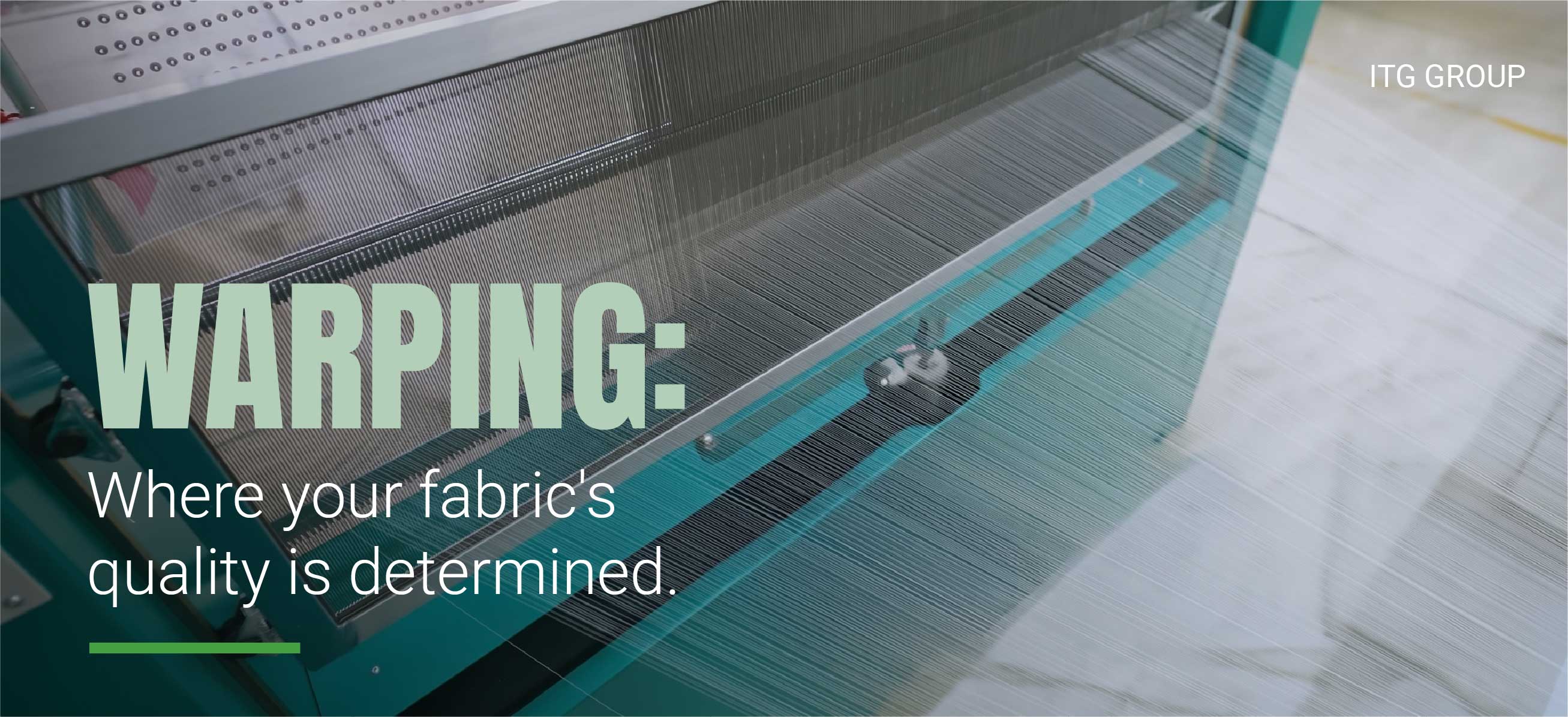
Here's an uncomfortable possibility: by the time yarn reaches the loom, a defect may already be wound into the beam.
Warp preparation is the quietest stage of the whole process. Nothing dramatic happens there. But it's where the conditions for fabric quality are set — and a badly warped beam carries its problems forward into every metre woven from it.
What a beam actually carries
A warp beam isn't just yarn on a flange. It's thousands of ends wound under a specific tension, at a specific density, in a specific arrangement. Get those three things right and the loom receives a warp it can work with. Get any of them wrong and the loom spends the whole run compensating.
We wrote in August about a study of loom stoppages in an air-jet weaving mill, which found that 58% of all stops were caused by warp breakages — by far the largest category, ahead of weft breaks and everything else combined. That article looked at the components the yarn passes through on the loom.
But there's a stage before that. A warp end that was wound under uneven tension, or that sat in a low-density zone of the beam, arrives at the loom already weakened or already slack. It doesn't break because the loom mistreated it. It breaks because it was never going to survive the run.
The three variables set at warping
1. Tension uniformity across the sheet. Every end on the beam should be wound under comparable tension. When some ends are tighter than others, the loose ones sag in the shed and the tight ones take more stress on every pick. The result at the loom looks like random warp breaks and shed irregularity — but the pattern was set when the beam was wound. This is why warping machines carry dedicated tension architecture: constant-tension mid-devices exist specifically to keep tension the same between different yarns and different strips, with the tension of each yarn sheet freely adjustable.
2. Winding density consistency. A beam wound at inconsistent density unwinds at inconsistent tension — because the effective diameter changes unevenly as the beam runs down. The catalog is direct about this: on the intelligent warping station, closed-loop tension control with tension units and automatic displacement measurement exist to "guarantee better winding of warp beam and keep constant winding density." On direct warping, winding density error is specified at ≤0.25%. And on detach warping, real-time tension compensation is what delivers density consistency not just within a beam, but between all the beams in a set — which matters the moment you're running a loom fed by more than one.
3. Stripe and band alignment. On sectional warping, where the warp is built in strips on a drum, alignment is everything. If the stripes drift, the resulting beam has zones of different density and the fabric shows it as banding. The engineering answer is geometric: on the SHGA215C, the warping section moves along a rail while the leasing reed and creel stay fixed, so the warp stripe stays aligned and centred throughout the process — and stripe tension stays constant with it. Precision figures on sectional warping run to ≤0.1 mm for strip location and 0.02% for conducting bar follow-up.
Why it stays invisible until the loom
Here's the structural problem: warping defects don't look like defects. A beam with uneven tension looks like a beam. A beam with 3% density variation looks identical to one with 0.25%. There's no visual inspection that catches it, and the warping department has usually moved on to the next beam by the time the first one reaches the loom.
So the feedback loop breaks. The weaving department logs warp breaks. The warping department hears nothing. And the same condition gets reproduced on every beam, because nobody connected the two ends of the problem.
Length accuracy behaves the same way. On our High Speed Direct Warping Machine GA269C, multiple sensors with automatic deviation correction hold length deviation under 0.0025% — a figure that only matters because the alternative is discovering the discrepancy at the end of a run, when you're short of fabric or long on waste and the beam is already gone.
Where the yarn is actually damaged
It's worth being precise about this, because "warping damages yarn" is too vague to act on. The damage happens at specific points, and each one has an engineering response.
At the creel, yarn is under tension and in motion, and friction-sensitive staple fibres are the most vulnerable. V-shaped recirculated creels are built for exactly this — they let yarn work under low tension at high speed, which reduces tension differences and end breakage during warping. Anti-air-balloon devices and pre-tension rods soften the tension compensation when the motor starts and stops, so the yarn isn't shocked at every acceleration.
At the pressure roller, the yarn is being compacted onto the beam. On the GA269C, pressure is adjustable from 150N to 6000N through an independent pneumatic mechanism, with automatic return during braking so the roller stops rubbing the yarn already on the beam. That automatic return exists because the alternative — a loaded roller sitting against a decelerating beam — abrades the outer layer.
And at the reed, dust and fly accumulate. Intermittent blow mechanisms and closed reed devices exist to keep that contact point clean, because a reed tooth carrying lint is a reed tooth abrading yarn.
A verification framework
If you're getting warp breaks or banding you can't trace, work through this before you keep adjusting the loom.
Check whether breaks cluster by beam, not by loom. If the same loom runs clean on one beam and breaks on the next, the variable isn't the loom.
Check whether breaks cluster by zone of the beam. Problems that appear consistently at a certain point in the run — early, middle, near the end — point to density variation across the beam diameter.
Compare beams within a set. If you're feeding a loom from multiple beams and one behaves differently, you have a between-beam density consistency problem, not a weaving problem.
Look at your banding against your stripe geometry. On sectional warping, banding that repeats at regular intervals across the fabric width is an alignment question, not a reed question.
Ask what tension your warping machine actually holds — and whether anyone measures it. If the answer is "it's set on the panel," that's a setting, not a measurement. Closed-loop tension control means the machine corrects; open-loop means it hopes.
Close the feedback loop. Give the warping department the warp-break data from weaving, by beam. It's the single cheapest diagnostic change available, and most mills have never done it.
The cost argument
For anyone weighing this as an investment rather than a maintenance question: warp preparation is upstream of everything. A defect introduced at the loom affects the fabric being woven. A defect introduced at warping affects every metre of every beam produced under those conditions — and it does so invisibly, which is what makes it expensive.
That's the asymmetry worth understanding. Warping equipment doesn't produce fabric, so it rarely gets prioritised in a capex conversation. But it sets the ceiling on what the rest of your line can achieve. You cannot weave better than your beam allows.
Where ITG Group fits
Our warping range covers direct and sectional warping, — with creel and tension configurations selected according to the yarn you actually run, not a default specification.
If you're seeing warp breaks or banding that don't resolve at the loom, that's a conversation worth having before your next equipment decision. Tell us what you're running and what you're seeing, and our technical team will work through it with you — including the case where the honest answer is that your warping is fine and the problem is somewhere else.
Get in touch: info@group-itg.com