
 英语
 汉语
Welcome to Our Blog - ITG Group
博客

- 纺织业
- Oct 14, 2026
Nextech 2026: Discovering Where the Textile Industry Is Headed
From September 22 to 24, we attended the first edition of Nextech by Colombiatex at Plaza Mayor in Medellín. It is Latin America’s first trade show specializing in machinery and technology for the textile and apparel supply chain. According to Inexmoda, Colombia accounted for 6.8% of the Latin American fashion market in 2025—approximately USD 8,494 million—and the industry is asking itself how to produce better, not just more.
At our booth, we had knitting looms, braiding machines and SINOTEX flat knitting looms in operation. We had visitors from different cities in Colombia, as well as from Ecuador, Peru, Argentina, and Europe, and a good portion of them were companies we hadn’t worked with yet. Almost all conversations revolved around four topics.
Topic 1: Knitting remains the foundation, but growth doesn’t always mean buying another machine
This was the most frequently asked question. Before adding a machine, check if you can diversify with the one you already have:
Change parts, not the machine. On single-knit knitting machines, by changing the core components, the same machine can be converted to knit terry or polo fabric.
Change the gauge with a new cylinder. You can produce a different type of fabric with the same equipment and a much smaller investment than that of a complete machine.
Choose wisely between tubular and open-width knitting. If you work with fabrics containing Lycra or light colors and the fold of the tube leaves marks, the open-width method rolls up the spread-out fabric, preventing those wrinkles and maintaining a uniform stitch density. If you produce garments without side seams, the tubular method remains the most efficient option.
Topic 2: For collars and cuffs, the difference lies in the design
Every technique you master is one more product you can offer: mini jacquard, embossed pleats, intarsia, transfers, or shaped collars. If you’re evaluating a flat knitting machine, keep this in mind:
Rising and lowering rollers: the fabric comes out straight without needing to be hung by hand.
High-heel needles: the cams wear less.
Servo-controlled motor: according to the manufacturer, it increases production by 15%.
Four lancing bars and eight feeders: more colors in a single design.
Topic 3: In braiding, continuity comes down to the details
Braiding is used in shoelaces, sports and safety ropes, fishing line, headphone cables, and jacquard cords, made of polyester, nylon, PP, or Dyneema. If you’re considering a braiding machine:
It’s part of the final product. The number of spindles and heads determines what you can produce and at what rate.
Look for an automatic shut-off in case of thread breakage to avoid accumulating defective lengths. According to the manufacturer, some rope-making models produce 4 to 5 times more than a traditional braiding machine.
Keep consumables close at hand. With spools, carriers, springs, and brake pins readily available, a stoppage lasts hours rather than weeks.
Think about the finishing. If you produce cords, an automatic stitching machine capable of 4,000 to 6,000 stitches per hour completes the process without relying on manual labor.
Topic 4: The cutting room has become a major topic of conversation
Automatic fabric spreading and cutting machines—a line we recently introduced with YINENG TECH—were among the most frequently inquired about. Fabric typically accounts for 60% to 70% of a garment’s cost, and Lectra estimates that waste in cutting rooms ranges from 10% to 20%. It is one of the largest cost centers in a garment manufacturing operation and almost always the least measured.
Before looking at any technical specifications, measure these four things over the course of a typical month: your marking efficiency by garment type, your scraps and rework by cause, the actual hours your cutting table is in use, and your true bottleneck (consistency, setup time, or volume). Also, evaluate spreading and cutting together. An automatic cutting machine only cuts the fabric layout it is fed. If the fabric is still laid out by hand, you’ve automated the precise step and left the imprecise one as it was.
Before Making a Decision
Anyone returning from a trade show comes back with options on the table. These four questions help you sort through them:
What are you going to produce, and for which market?
What is the actual productivity with your yarn and your shifts?
Are replacement parts available nearby?
What does the support for installation, commissioning, and training include?
Most decisions to invest in machinery are made months after a trade show, when there’s time to compare options calmly. We’ve seen this happen in other divisions of the group, which is why we never consider any conversation closed. If you submitted a request, our sales team will reach out to you to help bring it to life. And if you didn’t get a chance to visit us or want to discuss any of these topics for your plant, please write to us.
Thank you to everyone who stopped by to visit us during Nextech.
- 纺织业
- Jul 14, 2026
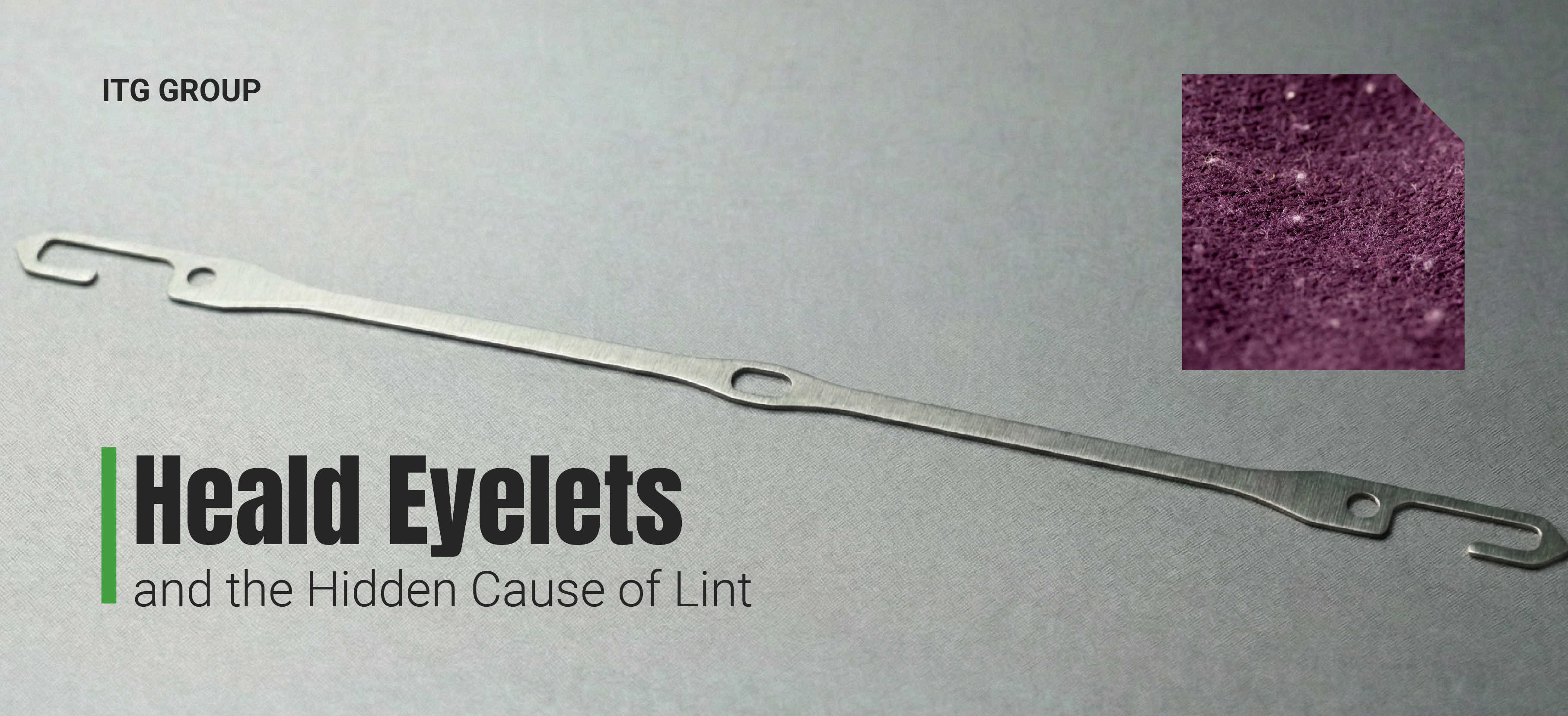
Heald Eyelets and the Hidden Cause of Lint
Every shedding cycle puts the warp yarn through the same point of contact: the heald eyelet. As the warp yarn bends at the eyelet during shedding, elongation occurs proportional to the square of the shed height — and because the front and back of the shed are asymmetrical in length, the yarn slips inside the eyelet, generating friction. When upper and lower yarns rise and fall alternately, severe friction occurs between them. During beating-up, the back-and-forth motion further increases friction between the warp yarn and the heddle eyelet.
This isn't an occasional event. It happens on every pick, on every heald, for the entire production run.
The cumulative cost of friction
The damage adds up in ways that show up directly on the production floor. Studies have found warp yarns lose up to 12% of their breaking tenacity due to abrasion and friction against fiber-to-fiber contact and all loom components — with peak friction occurring during weft insertion.
Lint is generated specifically at the points where warp yarns pass through drop wire eyes, heddle eyes, and between reed blades. This lint collects on the weaving machine surfaces and is often incorporated into the fabric when it falls into the shed or becomes entwined with warp or weft yarns, resulting in defective fabric. Thick lint buildup can also clog loom mechanisms and mix with lubricating oil.
The result is a chain of consequences mills know well: thin places, gouts, oily streaks, and broken ends — if the warp becomes too hairy, the reed forms a ball of fiber between the reed and heald shaft, and if small enough, that ball passes through and becomes a defect woven directly into the fabric.
Sizing helps — but it doesn't solve the problem at the source
Warp yarns are typically sized — coated with protective agents like starch or polyvinyl alcohol to improve abrasion resistance and reduce friction. This is a necessary step, but it addresses the yarn side of the equation. The eyelet itself — the physical surface the yarn contacts thousands of times per minute — is the other half of the equation, and it's often overlooked.
What eyelet geometry actually does
Heald design research is specific about which physical features reduce yarn damage at this contact point. Rounding the front and rear edges of the heald reduces stress on the yarn. A planar lateral surface at the eyelet — without sharp upper or lower corners — prevents the yarn from being forced onto edges where it could be wedged and damaged. This allows even thermally sensitive yarns to be processed at high operating speeds without damage from sharp edges or friction heat.
In other words: the smoother and more rounded the eyelet surface, the less mechanical stress the yarn absorbs on every single pass — which translates directly into less fiber shedding, less lint generation, and fewer downstream fabric defects.
Where ITG Group's healds and droppers fit?
ITG Group's healds and droppers are manufactured with this contact point as a quality priority. Made from 420J stainless steel — a grade selected for its superior hardness and corrosion resistance — the eyelet surface is smooth and abrasion-resistant, and components are processed through acid-washing, polishing, and electrolysis to further improve anti-rust performance and reduce surface friction at the point of yarn contact. This combination of material and finishing directly addresses the root causes of lint buildup: rough contact surfaces that break fibers rather than guide them.
The full ITG Group range covers closed and open type flat steel healds, steel wire healds with grooved mail-eye, drop wires (EO and EG types across multiple sizes), and specialty healds for linen weaving and jacquard looms — giving mills the ability to match eyelet type and finish to the specific yarn and fabric they're running.
For mills dealing with recurring lint-related defects or accelerated yarn wear, the heald and dropper eyelet is often the first place worth inspecting — not just the yarn.
If you'd like to review which heald and dropper specifications best match your current loom setup and yarn type, ITG Group's technical team can help.
Sources: Statista, Grand View Research, Femme Hub, Mordor Intelligence, Oxano.

- 纺织业
- Mar 23, 2026
High-Performance Braiding for Marine Applications
The maritime and fishing sector is not a seasonal niche or a passing trend; it is a structural industry built on critical operational infrastructure. Mooring ropes, large-diameter hawsers, and industrial fishing nets sustain vessels, port operations, and aquaculture systems worldwide. This permanent dependency makes the segment a technical and commercial opportunity that goes far beyond traditional textile markets.
From a market perspective, the data confirms its relevance. The global fishing nets market was valued at approximately US $1.67 billion in 2024 and is projected to grow at a compound annual growth rate (CAGR) of around 4.6% through 2034, driven by the expansion of commercial aquaculture and the increasing adoption of high-performance synthetic nets. This figure reflects only the fishing net segment and does not include mooring ropes, industrial hawsers, and other maritime applications, indicating that the total market linked to marine braided products is significantly larger.
Beyond its size, the attractiveness of this industry lies in its structural demand. Nets degrade due to constant abrasion and prolonged exposure to saline environments. Mooring ropes lose strength over time because of mechanical fatigue. Vessels require continuous maintenance. This dynamic creates consistent replacement cycles and lower volatility compared to textile markets driven by discretionary consumption.
The economic opportunity is directly connected to technical capability. Not all braiding machines are designed to manufacture competitive maritime products. Producing hawsers and large-diameter ropes requires reinforced frames, stable transmission systems, and sufficient motor power to maintain uniform tension in structures that can exceed 80 mm in diameter. In addition, the number of spindles directly affects braid density, improving load distribution and abrasion resistance—critical factors when products must withstand high dynamic loads.
The sector has also evolved toward high-performance synthetic fibers such as high-tenacity polyester, industrial nylon, technical polypropylene, and ultra-high-modulus fibers. These materials are progressively replacing metallic solutions in certain applications due to their lower weight and superior corrosion resistance. However, they require precise tension control and mechanical stability during the braiding process to preserve their structural properties.
In this market, purchasing decisions are based on performance, durability, and operational safety. This reduces price-only competition and enables stronger margins compared to conventional textile applications. The combination of application value, technical entry barriers, and structural demand creates favorable conditions for solid returns when supported by the appropriate production capabilities.
Braiding machines designed specifically for rope, hawser, and industrial maritime applications make it possible to participate competitively in this segment. In this context, the specialized solutions available within the ITG Group portfolio respond directly to the technical demands of the maritime and fishing industry, integrating large-diameter capacity, high spindle density, and operational stability for high-performance applications.

- 纺织业
- Feb 17, 2026
Selecting Heald Frames for High-Performance Weaving
When investing in weaving equipment, heald frames are often underestimated. However, experienced textile professionals know that the performance, stability, and longevity of a loom depend heavily on the quality of its frames. Choosing the right heald frames is not just a technical decision — it is a strategic one that directly affects fabric quality, machine efficiency, and operating costs.
One of the first factors to consider is material quality. Heald frames must withstand continuous motion, tension, and vibration, especially in modern high-speed looms. Frames made from high-grade aluminum alloys or reinforced materials offer the best balance between strength and weight. A lighter frame reduces inertia, allowing smoother movement and higher operating speeds, while sufficient rigidity prevents deformation over time.
Another critical aspect is dimensional accuracy and structural stability. Poorly manufactured frames can warp or lose alignment, leading to uneven shed formation. This results in fabric defects, increased yarn breakage, and unnecessary stress on other loom components. Precision manufacturing and strict tolerances ensure consistent performance, even under demanding weaving conditions.
Surface finish and assembly quality also play an important role. Smooth surfaces reduce friction and wear, especially where frames interact with healds and droppers. High-quality welding, fastening, and joint design prevent loosening or micro-vibrations that can compromise fabric consistency and machine reliability over long production runs.
Compatibility is another key consideration. Heald frames must be engineered to match the specific loom type — whether rapier, air-jet, or projectile — as well as the operating speed, fabric style, and tension requirements of each application. Proper compatibility ensures stable motion, accurate shedding, and reduced mechanical stress, allowing the loom to operate efficiently without unnecessary vibration, adjustments, or premature wear. Frames that are correctly matched to the loom and fabric perform more reliably and support consistent production over long runs.
Maintenance and service life should not be overlooked. Frames designed with durability in mind reduce the frequency of replacements and maintenance interventions. Over time, this translates into lower operating costs, fewer unplanned stoppages, and more stable production schedules — all essential for competitive textile manufacturing.
The qualities outlined above — material strength, structural stability, dimensional precision, compatibility, and long-term durability — are exactly the principles behind the heald frames offered by ITG Group. Designed to perform in modern, high-speed weaving environments, ITG frames are compatible with leading loom brands such as Toyota, Tsudakoma, and Picanol, meeting the expectations of experienced textile producers. By prioritizing reliability, stability, and precise manufacturing, ITG Group’s heald frame solutions support consistent fabric quality and dependable production, day after day.